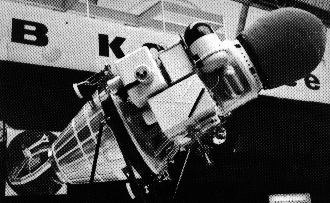
Luna 10 was launched on 31 March 1966 and Luna 12 on 22 October 1966. They were the first Luna spacecraft intended to go into orbit around the moon, rather than soft or hard landing there. On 3 April 1966, Luna 10 was put into a selenocentric orbit — becoming the moon’s first man-made satellite. It had an apogee of 1015 km, a perigee of 350 km, an inclination to the equatorial plane of 72°. The orbital time was 2 hours 58 minutes. The Luna 12 orbit was: apogee 1740 km, perigee 100 km, inclination 20°, orbital time 3 hours 25 minutes. Both missions carried instrumentation to study the Moon and cislunar space. The instruments comprised a multichannel scintillation gamma-ray spectrometer intended to measure the moon’s gamma-radiation. However, the Luna 10 and 12 spacecraft both measured the cosmic gamma-ray background during their flight to the moon.
Mission Characteristics
Lifetime
Mar–Oct 1966
Special Features
First man-made satellites to orbit the Moon
Early cosmic gamma-ray background measurements
Lifetime
Mar–Oct 1966
Special Features
First man-made satellites to orbit the Moon
Early cosmic gamma-ray background measurements
Payload
Instrument
Characteristic
Details
Gamma Ray Detectors
Energy Range
0.3–3.0 MeV
Both satellites carried 40 × 40 mm NaI(Tl) scintillators. There was 32 channel energy resolution. The detector aboard Luna 10 was housed inside the satellite and that of Luna 12 was outside.
Gamma Ray Detectors
Energy Range
0.3–3.0 MeV
Both satellites carried 40 × 40 mm NaI(Tl) scintillators. There was 32 channel energy resolution. The detector aboard Luna 10 was housed inside the satellite and that of Luna 12 was outside.