Energy Range
100–2000 keV
Field of View
4π sr (all-sky)
Time Resolution
11.7 ms (normal), 0.25 ms achievable
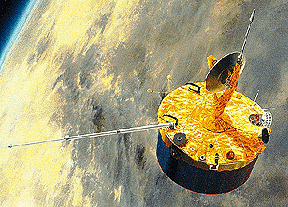
The Orbiter Gamma Burst Detector (a joint Los Alamos National Laboratory/ Sandia National Laboratory effort) was designed to record the temporal and spectral characteristics of cosmic gamma-ray bursts. The primary objective of the experiment was the accurate determination of the directions to the sources of such bursts through a technique of triangulation as a member of a widely spaced array of similar instruments (ISEE-3, Venera-11 & 12, Helios-2). The system consisted of a pair of scintillation spectrometers, together with logic and data storage to provide a capability for recording these events. The gamma ray burst detector went into operation on 21 May 1978, one day after launch. It operated continuously until PVO fell into Venus in 1992.
The complete system, including connecting cables, weighed 2.9 kg and operated on 1 Watt of electrical power. The sensors were mounted at the periphery of the Orbiter spacecraft equipment platform, diametrically opposite each other. Thus, there was nearly uniform omnidirectional coverage. The sensors were actively guarded scintillation photon counters, each containing a 3.8 cm diameter x 3.2 cm long CsI scintillation crystal. The crystal was optically bound to a 0.5 cm shell of plastic scintillator. The composite scintillator (or phoswich) was passively shielded from low energy radiation by a jacket of 0.25mm lead foil and the sensor housing.
In the absence of a gamma ray event, the instrument operated in a real time background mode. These data included background count rates, spectra, state of health information, and source calibration. The background spectral information was taken in 4 energy channels. Events were determined by a statistically significant increase in counting rate. Since it is important to see the beginning of a burst, a pre-trigger memory was included. The data stream was continuously routed to the pre-trigger memory, which kept it for about 3 seconds. In background mode, the oldest data were continuously replaced by newer data. However, once a trigger occurred, the contents of the pre-trigger memory were transferred to the main memory. In this way, the onset of an event was recorded even though it occurred before the event was recognized by the system. The event data were accumulated into 5 energy channels. Channel 1 covered the energy range 0.1–2.0 MeV. Channels 2–5 were defined by thresholds at 0.1, 0.2, 0.5, 1.0, and 2.0 MeV. The normal accumulation time for Channel 1 was 11.7 ms, although 0.25 ms resolution was achievable.