Time Resolution
2 ms, 16 ms, or 256 ms (mode dependent)
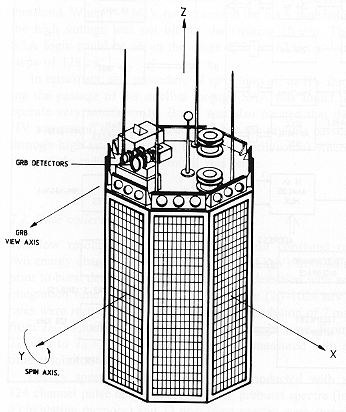
The GRB experiment operated from 25 May 1992 until reentry on 14 July 1992. The instrument consisted of a main and a redundant CsI(Na) scintillator. The crystals were 76 mm (main) and 37 mm (redundant) in diameter. Each had a thickness of 12.5 mm. A 'burst mode' was triggered by the 100–1024 keV count rate exceeding a preset limit during a 256 or 1024 ms time integration. In this mode, 65 s of temporal and 2 s of spectral data prior to the trigger are stored, as well as the subsequent 16 s of spectral data and 204 s of temporal data. The low resolution data consists of 2 energy channels (20–100 keV and 100–1024 keV) from 65 s before the trigger to 204 s after the trigger in 256 ms integrations. The 20–1024 keV rates are also recorded with a 2 ms resolution for 1 s prior to 1 s after trigger and a 16 ms resolution for 1s prior to 8 s after the trigger. Energy spectra are conducted with a 124 channel PHA. Four pre-trigger spectra and 32 post-trigger spectra are recorded for every burst with a 512 ms integration time.
During the mission lifetime, 53 triggers occurred. Most of these, as expected, were false. There were 8 candidates for “real” bursts. One event, on 22 June, was also seen by CGRO and is believed real. Two other events could be real, as CGRO was not recording data at the time and so could not corroborate their occurrence.