
Come analyze HEASARC, IRSA, and MAST data in the cloud! The Fornax Initiative is now welcoming all interested beta users.


nest
run a nested-sampling exploration
| Syntax: | nest | <subcommand>[<args>] |
|---|
The nest command runs a multi-ellipsoidal nested sampler over
the currently-thawed model parameters. Unlike chain and
hmc, nested sampling produces a sequence of weighted
posterior samples plus an estimate of the marginal likelihood (model
evidence) 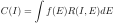 , computed by likelihood-restricted prior sampling
inside a contracting envelope of bounding ellipsoids. See the
nested-sampling discussion in Chapter 3 for the
algorithmic background and Section 3.4 for a
worked example.
, computed by likelihood-restricted prior sampling
inside a contracting envelope of bounding ellipsoids. See the
nested-sampling discussion in Chapter 3 for the
algorithmic background and Section 3.4 for a
worked example.
nest requires proper, integrable priors on every thawed parameter. Parameters with default flat priors over a hard range that spans more than four decades (typical of column densities and normalisations) cause nest to refuse to start; in such cases either narrow the parameter limits via newpar or assign a Jeffreys prior via bayes JEFFREYS before invoking nest run. See Chapter 3, Section 3, for the available prior families.
nest does not warm-start from a fit – it samples from the prior and contracts inward. A fit is therefore not required before nest run, but it is useful for diagnosing the prior choice: if the MLE lies in a region the prior assigns very low probability the run will spend many iterations in the contraction phase before finding the likelihood peak.
By default nest runs in a single process. Set
parallel nest <N> to run with  worker processes
sharing the likelihood-restricted sampling pool, which gives
sub-linear but significant speed-up.
worker processes
sharing the likelihood-restricted sampling pool, which gives
sub-linear but significant speed-up.
- run <fileName>
- Executes the
sampler and writes the output to <fileName>. The file
contains two FITS extensions: a NEST table with the weighted
nested samples and their log-likelihood / log-weight columns, and a
CHAIN table with equal-weight resampled draws compatible
with chain load. Prefix the filename with
! to discard any existing checkpoint and overwrite.
Without the prefix, if a checkpoint file
<fileName>.ckpt.fits exists and is dimensionally compatible
with the current model, nest run resumes from the saved
iteration count.
- live <N>
- Number of live
points (the size of the contracting ellipsoid pool). Default 400.
More live points give a finer-grained estimate of and reduce
the chance of missing isolated modes, at proportional cost.
Conventional values run from 100 (cheap exploration) to 2000
(production-grade evidence for paper figures).
- tol <eps>
- Skilling
log-evidence termination tolerance. Default 0.5. Sampling stops
when the residual evidence in the live points falls below
<eps> times the accumulated total. Smaller values run longer
and produce tighter estimates.
- enlarge <factor>
- Enlargement factor applied to the volume of the bounding ellipsoids
before drawing new live points. Default 1.2. Larger values reduce
the chance of clipping the true iso-likelihood contour at the cost
of more sampling per replaced live point.
- clusters <K>
- Maximum
number of ellipsoids used to bound the live-point cloud. Default 16.
Setting 1 forces the single-ellipsoid algorithm of Mukherjee
et al. (2006), which is faster but cannot follow multi-modal
posteriors; the default uses the X-means split heuristic to grow the
ellipsoid count up to the cap as needed.
- resample <N>
- Number of
equal-weight posterior draws to write to the CHAIN
extension. Default 4000. These are produced by importance
resampling from the weighted NEST table and are what
chain load will see if it is pointed at the output
file.
- checkpoint <N>
- Write a
checkpoint every <N> iterations. Default 200. Set
0 to disable checkpoint writing.
- info
- Print the current sampler
settings.
- evidence
- Print the
estimate and its uncertainty from the most recent run.
Examples:
XSPEC> newpar 1 0.05 0.001 1e-6 1e-6 100000 1e6
XSPEC> newpar 5 0.04 0.01  1e-30 1e-30 1e20 1e24
XSPEC> bayes on
XSPEC> bayes 1 JEFFREYS
XSPEC> bayes 5 JEFFREYS
XSPEC> parallel nest 4
XSPEC> nest live 400
XSPEC> nest run nest.fits
XSPEC> nest evidence
The newpar commands narrow the search ranges of the absorber column and apec normalisation (otherwise their default 31-decade ranges would cause nest to refuse to start), and the bayes JEFFREYS commands switch them to log-uniform priors so that the search proceeds over the full narrowed range without favouring large absolute values.