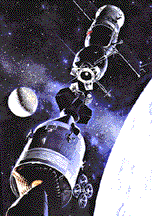
The Apollo-Soyuz mission occurred in July, 1975. In addition to the manned mission objectives of international space cooperation, testing universal docking systems, etc., Apollo-Soyuz carried a number of scientific instruments.
Mission Characteristics
Lifetime
Jul 1975
Special Features
The U.S. portion of the mission carried a proportional counter system sensitive to 0.18–0.28 and 0.6–10.0 keV X-rays.
Lifetime
Jul 1975
Special Features
The U.S. portion of the mission carried a proportional counter system sensitive to 0.18–0.28 and 0.6–10.0 keV X-rays.
Payload
Instrument
Characteristic
Details
ASTP S150 X-ray Proportional Counter
Energy Range
0.18–10 keV
Effective Area
150 cm2 (combined)
Field of View
4.5° (FWHM) circle
The NRL-built S150 experiment consisted of three gas-filled proportional counters with a thin beryllium window.
ASTP S150 X-ray Proportional Counter
Energy Range
0.18–10 keV
Effective Area
150 cm2 (combined)
Field of View
4.5° (FWHM) circle
The NRL-built S150 experiment consisted of three gas-filled proportional counters with a thin beryllium window.
Science Highlights
Results from this experiment included the discovery of soft X-ray emission from the supernova remnant MSH 14-63 and of rapid pulsations (0.716 s) from the binary SMC X-1. Due to the (comparatively) short duration of the Apollo-Soyuz mission, little other science of note was done with the proportional counter system. In addition, the detector had a moderately high background level that steadily increased through the duration of the mission until almost no X-ray sources were discernible. The cause of the background problems remains unknown.