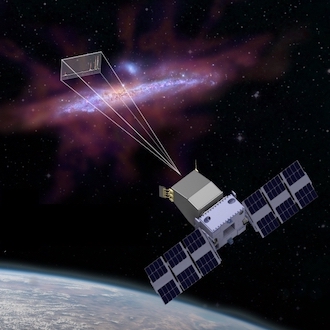
Aspera


Aspera satellite studying EUV halo of a galaxy for diffuse hot coronal gas

The Aspera mission is an extreme UV (EUV) astrophysics small satellite telescope designed to map the warm-hot phase coronal gas around nearby galaxy halos. Aspera will search for faint and diffuse OVI line emission using a suite of four spectrographs based on a similar in design to the successful FUSE mission.

Aspera is funded through the inaugural 2020 NASA Astrophysics Pioneers program for small missions and has an anticipated launch date in late 2024. The SmallSat configuration will rideshare to a low Earth Sun-synchronous orbit. The satellite is 335.6 x 254.0 x 395.29 mm in size and has a ~24 kg mass. The optical coatings will degrade in the space environment and thus set a limit on mission operations: performance would be degraded by about 7% after nine months of operation.

The 103.2,103.6 nm OVI doublet line emission is extremely faint and distributed over very wide angular areas and thus very challenging to observe with current and recent past space-based UV instruments. Aspera is fine-tuned to observe this diffuse faint spectra.

Mission Characteristics

* Lifetime : Nine months from launch (projected late 2024)

* Energy Range : 11.92–12.03 eV (103.0–104.0 nm)

* Special Features : Spectrographs with coated optics to reflect EUV light and gratings to study a very narrow spectral band around the 103.2,103.6 nm OVI line.

* Payload :

  • Spectrograph. The sole observational instrument is a suite of four modified Rowland-Circle spectrographs with parallel channels. Each is equipped with a 6.2 cm x 3.7 cm off-axis parabolic mirror and a toroidal diffraction grating, a flight-proven variant similar to that used in FUSE, but with a lower spectral resolution in order to make it more sensitive to diffuse sources. The optical surfaces uses Al+LiF coatings. The detectors are micro-channel plates. Each of the four spectrographs are offset from each other by 60′ along the slit width direction.
    • Effective area : 1.85 cm2 at 103.5 nm (11.98 eV)
    • Angular resolution : < 60 arcsec
    • Field of View : 60 arcmin x 30 arcsec
    • Focal length : 171.2 mm
    • Spectral Resolution: < 0.07 nm at 103.5 nm (λ/δλ >1500)

* Science Highlights:

  • Map and characterize circumgalactic medium