EUSO-SPB2


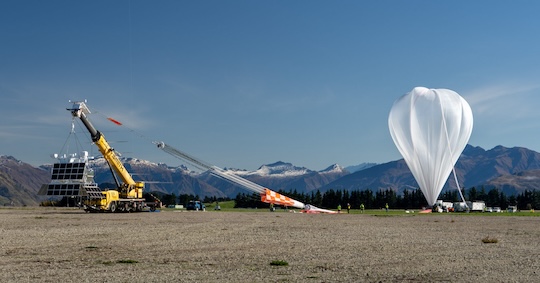
The EUSO SPB2 mission during launch at Wanaka, New Zealand

The Extreme Universe Space Observatory Super Pressure Balloon 2 (EUSO-SPB2) mission was a ultrahigh-energy cosmic-ray detector flown in the Earth’s stratrosphere. It was held aloft by a NASA super pressure balloon which is designed to maintain stable altitude for long duration flights. EUSO-SPB2 launched from Wanaka Airport in New Zealand on May 13, 2023, and ended prematurely after 1.5 days due to a leak in the balloon. There were two other prior flights: EUSO-Balloon, an extremely brief (several hours) flight pathfinding mission on August 25, 2014 from Timmins Balloon Base in Ontario, Canada; and EUSO-SPB(1) launched April 24, 2017 and ending 12 days later, also launched from Wanaka.

EUSO-SPB2 had signficant upgrades to instrumentation compared to its predecessor flights. Both EUSO-SPB1 and SPB2 were overseen and operated by NASA’s Columbia Scientific Balloon Facility in Palestine, Texas; EUSO-Balloon was overseen by the French Space Agency CNES. All flights were proving ground missions for the larger NASA-led Probe of Multi-Messenger Astrophysics (POEMMA) to detect ultra-high energy cosmic rays (E >1 EeV) and very-high energy neutrinos (E >1 PeV) from space.

EUSO-SPB2 was outfitted with two telescopes using reflective optics and coatings. The Fluorscence Telescope (FT) observed UV light from air showers by observing the atmosphere below the instrument. The Cherenkov Telescope (CT) was a tiltable optical telescope to observe lower energy cosmic rays from their Cherenkov signature when pointed above the limb; when pointed below the limb, it measured optical background and neutrino signatures from upward-moving air showers. The entire gondoal would rotate for azimuthal pointing of the CT. Earlier versions of EUSO lacked the CT instrument and rotation, and their versions of FT used light-weight plastic Fresnel lens optics with smaller fields of view. All versions of the FT used high time and spatial resolution observations senstive over a wide dynamic range to observe faint and bright air shower components. The telescope systems and associated electronics were mounted on a gondola suspended under the balloon. Astrophyiscal observations were made at night while the Moon was below the horizon, with daylight flight portions dedicated to battery recharging from solar panels.

Mission Characteristics

* Lifetime : 1.5 days (EUSO-SPB2); 12 days (EUSO-SPB)

* Energy Range : 1– ~30 EeV; peak sensitivity at 2.5 EeV (FT)

* Special Features : UV fluorsence detection for extensive air showers from space
Cherenkov radiation detection from air showers

* Payload :

  • Fluorsence Telescope (FT). This instrument used a 1 m diameter Schmidt telescope with special mirror coatings to optimize reflectivity at UV wavelengths. The camera used Multi-Anode Photo Multiplier Tubes (MAPMTs) mounted together into a Photo Detection Module (PDM). The camera contained three such PDMs. Each PDM was covered with a 290–430 nm UV filter. .
    • Field of view: 36°×12° (11.1°×11.1° in EUSO-SPB1)
    • Angular resolution: ∼4 arcmin
    • Energy range: ∼1–30 EeV (cosmic rays)
    • Time resolution: 1 µs (2.5 µs in EUSO-SPB1)
  • Cherenkov Telescope (CT; EUSO-SPB2 only). This instrument used a 1 m diamter Schmidt telescope with four mirror segments with a bifocal alignment (meaning light focused in two distinct spots on the camera instead of one: a direct cosmic ray hit on the detector would register as a single spot, while light from outside the telescope would register as two, allowing the elimination of direct cosmic ray background noise). The camera used a 512 Silicon PhotoMultiplier (SiPM) detector to target very fast and bright signals as expected from Cherenkov emission from air showers. The CT could be pointed from horizontal to 10° below the limb, depending on science operation needs. The horizontal mode looked for direct Cherenkov light from lower-energy cosmic rays; the sub-limb mode looked for optical neutrino signatures from tau neutrino interactions.
    EUSO-SPB did not include the CT instrument.
    • Field of view: 6.4°×12.8° (vertical×horizontal respectively)
    • Angular resolution: 0.4°
    • Energy range: >∼1 PeV
    • Time resolution: 10 ns
  • University of Chicago Infrared Camera (UCIRC). Two identical cameras were pointed directly at nadir, co-observing the same patch of sky. These measured blackbody peaks in order to detect clouds and determine cloud top height, using the known relationship between these quantities. Information on the high cloud location and height was ised to determine by what extent the instanteous aperature to detect air showers was reduced by the presence of high altitude cloud cover.
    • Field of view: 24°×30°
    • Spectral range: 9.6–11.6 µm for one camera; 11.5–12.9 µm for other
  • Supporting architecture. EUSO-SPB2 was equipped with antennae for communications and data download, deployable ballast systems, power systems, all integrated within a gondola suspended under the balloon. It also featured an azimuthal rotator not present in prior flights which permitted steering of the CT instrument.

* Science Highlights:

  • Observe ultra-high energy cosmic rays from air showers
  • Observe very-energy energy neutrinos from upward-propogating air showers
  • Provide proving ground for new detection techniques as part of preparation for future POEMMA missions