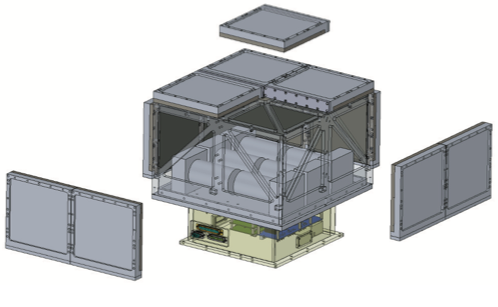
The Glowbug mission was a gamma-ray telescope
berthed on the International Space Station (ISS). It was launched on March 14, 2023,
and installed on the Japanese Experiment Module Exposed Facility (JEM-EF).
It began operations on March 20 2023, and operated through April 2024.
The mission was led by the Naval Research Laboratory through the
Department of Defense Space Test Program and funded through the NASA
Astrophysics Research and Analysis program. Its primary
mission was to detect short gamma-ray burst (sGRBs) from binary neutron star
and neutron star-black hole binary mergers. It was also a proving ground for a
proposed future SmallSat mission called GAMERA, the StarBurst Multimessenger Pioneers
mission, and Glowbug-2 instrument.
The instrument had a wide field of view and was sensitive
to gamma-rays in the 30 keV–2 MeV range. The detector consisted of
12 CsI(Tl) detector panels arranged to allow reconstruction of
burst location with modest accuracy. There were also a set of six
Cs2LiLaBr6(Ce) (CLLB) cylindrical detectors to
extend sensitive above ∼1 MeV. Both detectors used
silicon photomultipliers (SiPMs) to detect light from gamma-rays
absorbed by the scintillation material. The SiPMs and mission and data acquisition systems
were based on earlier technology from the Strontium Iodide Radiation Instrumentation missions
(SIRI-1 & SIRI-2).
The instrument was mounted on a pedestal to protude above the
zenithal (sky-facing) side of the ISS, ideal
for observing astronomical gamma-ray sources. Glowbug was
also able to detect some terrestrial gamma-ray flashes.
Mission Characteristics
Lifetime : March 2023–April 2024
Energy Range : 30 keV–2 MeV
Special Features :
- Mounted on the zenithal (sky-facing) side of the ISS with wide field of
view. ISS mounting and integration allowed use of power systems and high bandwidth
communications with limited onboard systems requirements.
- Leveraged flight-proven design and software for reduced cost and faster development.
- Improved gamma-ray detector design permitted greater sensitivity than older
designs.
Payload :
- CsI(Tl) Gamma-ray Detector. A suite of 12 CsI(Tl) detectors provided
an ultra-wide field of view of the unocculted sky (8 steridan). Each large-area
detector panel was a 150 mm x 150 mm, 10 mm thick crystal, with a 1 x 21 array of
6 mm x 6 mm SiPMS used to read out the thin edge of the crystal. The SensL J-series
SiPMs were flight-proven on the SIRI-1 mission. The individual detectors were
arranged in bi-packs, in pairs along the +/- x and y axis, and with four
on the +z (zenith-facing) side. The outward facing side of each panel had a thin
aluminum window while the crystal was backed with a steel and tantalum shield
which attenuated gamma rays below ∼300 keV to stop photons entering the
rear-facing side. Localization of bursts by maximum likiehood algorithms provided
typical localization of <5° (compared to 10° for comparable sGRBs with
the Fermi GBM) and roughly twice Fermi GBM's effective area with a typical sGRB
spectrum. This expanded the horizon for faint objects in the local Universe by a factor of
∼1.4 (and thus encompassed roughly 3 times Fermi GBM's detectable volume
of space).
- CLLB Gamma-ray Detector. There were 6 Cs2LiLaBr6(Ce) cylindrical
scintillation detectors in the interior of the detector (surrounded by the CsI(Tl) panels).
These were a new type of detector: a secondary goal of the Glowbug mission was to flight-test
the new technology. Each cylinder was 5 cm in diameter and 10 cm long with an array of 44
SensL J-series SiPM at one end. They had <4% FWHM spectral resolution at 662 keV and
were sensitive to thermal neutrons. They provided additional effective area above 1 MeV to the total
instrument.
- SAA Detector. The South Atlantic Anomaly detector consisted of a single
25 mm x 25 mm x 12 mm plastic scintillator cube with a 4 x 4 array of SiPM readouts. This
detector remained on during transits of the SAA in order to detect entry to and exit from the
high radiation region.
Science Highlights:
- Observed 65 GRBs (54 long and 11 short) during eight months of science
operations (The full year included initial boot-up, commissioning phases, and Safe Holds).
- Co-observed with other multi-messenger astronomy observatories.
- Provided additional data on terrestrial gamma-ray flash sources and solar flares.
- Flight proving of new CLLB scintillation detectors.
- Characterized the response of silicone photomultipliers on orbit, and determined
minimum power requirements for future missions to maintain operations through
end-of-mission timeframes for future Glowbug-2 and StarBurst missions.
Archive: HEASARC will host Glowbug data, products, and catalogs