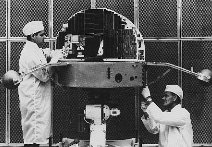
The Fourth Orbiting Solar Observatory (OSO 4) was launched on 18 October 1967. The objectives of the OSO-4 satellite were to perform solar physics experiments above the atmosphere and to measure the direction and intensity over the entire celestial sphere in UV, X, and gamma radiation. The OSO 4 platform consisted of a sail section (which pointed 2 instruments continuously toward the Sun) and a wheel section which spun about an axis perpendicular to the pointing direction of the sail (which contained 7 experiments). The spacecraft performed normally until a second tape recorded failed in May 1968. OSO-4 was put into a “standby” mode in November 1969. It could be turned on only for recording special events in real-time. One such event occurred on March 7, 1970 during a solar eclipse. The spacecraft became totally inoperable on 7 December 1971.
Mission Characteristics
Lifetime
Oct 1967–7 Dec 1971
Lifetime
Oct 1967–7 Dec 1971
Payload
Instrument
Characteristic
Details
X-ray telescope
Energy Range
∼8–200 keV
Energy Resolution
45% at 30 keV (6 channel resolution)
The X-ray telescope consisted of a single thin NaI(Tl) scintillation crystal plus phototube assembly enclosed in a CsI(Tl) anti-coincidence shield.
X-ray telescope
Energy Range
∼8–200 keV
Energy Resolution
45% at 30 keV (6 channel resolution)
The X-ray telescope consisted of a single thin NaI(Tl) scintillation crystal plus phototube assembly enclosed in a CsI(Tl) anti-coincidence shield.