
Come analyze HEASARC, IRSA, and MAST data in the cloud! The Fornax Initiative is now welcoming all interested beta users.


The Ariel V Satellite
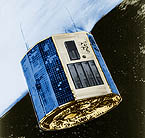

Artistic impression of Ariel 5 in orbit

Ariel V was launched into a low inclination (2.8°) orbit from the San Marco launch platform in the Indian Ocean on 15 October 1974. The mission was a British-USA collaboration. The Science Research Council managed the project for the UK and GSFC/NASA for the USA. Ariel V was dedicated to monitoring the X-ray sky with a comprehensive payload. The mission ended in the spring of 1980.

Mission Characteristics

Lifetime
15 Oct 1974–14 Mar 1980
Special Features
Monitored the X-ray sky with six different instruments. Four instruments (RMC, HRPCS, Polarimeter/Spectrometer, and Scintillation Telescope) were aligned with the spin axis and studying the region of sky within ∼10 degree of the axis, with the other two experiments covering wide swaths of the sky.

Payload

Rotation Modulation Collimator (RMC)

Energy Range
0.3–30 keV
Angular Resolution
∼2′

High resolution proportional counter spectrometer

Energy Range
2–30 keV
128 channel pulse high analyzer

Polarimeter/spectrometer

Energy Range
2–8 keV
Capable of detecting polarization of 3%

Scintillation telescope

Energy Range
up to 40 keV
Devoted to temporal and spectral studies of sources

All Sky Monitor (ASM)

Energy Range
3–6 keV
Effective Area
∼1 cm2 each
Pair of small pinhole cameras, viewing the entire sky outside of an ∼8° wide area around the spacecraft’s “south” pole. It was intended as an early detection system for transient events, and a continuous monitor of relatively bright (> 0.2 Crab) galactic sources

Sky Survey Instrument (SSI)

Energy Range
1.2–19.8 keV
Effective Area
290 cm2 each
Field of View
0.75° × 10.6° (FWHM) scanning
20° × 360° sky band along the satellite spin equator with each spin
Pair of proportional counters with different energy coverage: 1.2–5.8 keV (LE) and 2.4–19.8 keV (HE). The primary sciences goals for the SSI was conducting a high-sensitivity survey of the sky and to obtain locations, intensities, and spectra of interesting sources.

Science Highlights

  • Long-term monitoring of numerous X-ray sources
  • Discovery of several long period (minutes) X-ray pulsars
  • Discovery of several bright X-ray transients probably containing a black hole (e.g. A0620-00, Nova Mon 1975)
  • Establishing that Seyfert I galaxies (AGN) are a class of X-ray emitters
  • Discovery of iron line emission in extragalactic sources

Archive

The HEASARC hosts lightcurves from the ASM, raw data, and the 3rd Ariel V catalog