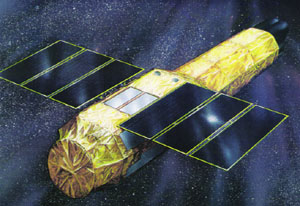
Astro-E was to be the Japan’s fifth X-ray astronomy mission, but was lost during launch on 10 Feb 2000. Astro-E was developed at the Japanese Institute of Space and Astronautical Science (ISAS) in collaboration with the US and Japanese institutions. Astro-E was to carry, among other instruments, a new type of X-ray spectrometer, the X-ray micro-calorimenter, which would have provided an unprecendent energy resolution compared to non-dispersive instruments.
The mission was rebuild as ASTRO-E2, renamed Suzaku, that was successfully launched in 2005 and operated for 10 years.
Mission Characteristics
Lifetime
10 Feb 2000 (launch failure)
Special Features
First X-ray micro-calorimeter in space
Lifetime
10 Feb 2000 (launch failure)
Special Features
First X-ray micro-calorimeter in space
Payload
Instrument
Characteristic
Details
X-ray Telescope (XRT)
Energy Range
0.2–12 keV
Focal Length
4.75 m (XRT-S) 4.5 m (XRT-I)
Angular Resolution
∼2′
Five nested conical thin-foil grazing incidence telescopes, all gold-coated. Four were XRT-I used for the XIS instrument, the fifth XRT-S served the XRS instrument.
X-ray Spectrometer (XRS)
Energy Range
0.3–12 keV
Effective Area
190 cm2 at 1.5 kev
Field of View
2.9′ × 2.9′
Energy Resolution
∼6.5 eV at 6 keV (FWHM)
An X-ray microcalorimeter composite of 32 pixels at the foci of the XRT-S
X-ray Imaging Spectrometer (XIS)
Energy Range
0.2–12 keV
Effective Area
340 cm2 (FI) 390 cm2 (BI)
Field of View
18′ × 18′
Energy Resolution
130 eV at 6 keV
Four 1024×1024 pixel CCD detectors at the foci of one of the XRT-I. Three are front illuminated (FI), one is back illuminated (BI).
Five nested conical thin-foil grazing incidence telescopes, all gold-coated. Four were XRT-I used for the XIS instrument, the fifth XRT-S served the XRS instrument.
X-ray Spectrometer (XRS)
Energy Range
0.3–12 keV
Effective Area
190 cm2 at 1.5 kev
Field of View
2.9′ × 2.9′
Energy Resolution
∼6.5 eV at 6 keV (FWHM)
An X-ray microcalorimeter composite of 32 pixels at the foci of the XRT-S
X-ray Imaging Spectrometer (XIS)
Energy Range
0.2–12 keV
Effective Area
340 cm2 (FI) 390 cm2 (BI)
Field of View
18′ × 18′
Energy Resolution
130 eV at 6 keV
Four 1024×1024 pixel CCD detectors at the foci of one of the XRT-I. Three are front illuminated (FI), one is back illuminated (BI).