
Come analyze HEASARC, IRSA, and MAST data in the cloud! The Fornax Initiative is now welcoming all interested beta users.


The Copernicus Satellite (OAO-3)
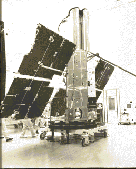

Photograph of Copernicus satellite in the clean room

Copernicus, or Orbiting Astronomical Observatory 3 (OAO-3) was a collaborative effort between the USA (NASA) and the UK (SERC). The main experiment on board was the Princeton University UV telescope, but it also carried an X-ray astronomy experiment developed by the University College London/Mullard Space Science Laboratory.

Mission Characteristics

Lifetime
21 Aug 1972–Feb 1981
Special Features
  • The three proportional counters were also equipped with a six channel pulse height analyzer for obtaining coarse X-ray spectra. All instruments (X-ray and UV) were co-aligned.
  • First multi-wavelength NASA mission (UV and X-ray instruments on the same satellite)

Payload

University College London X-ray Experiment (UCLXE) telescope

Energy Range
0.7–1.5 keV (low energy)
1.4–4.2 keV (high energy)
Wavelength
6–18 Å (low energy)
3–9 Å (high energy)
Effective Area
1.0–12.3 cm2 (variable)
Field of View
1–12′ (variable)
Two proportional counters (one each of low and high energy) and a channel photomultipier (“channeltron”), each with Wolter type 0 grazing incidence X-ray mirrors.

University College London X-ray Experiment (UCLXE) proportional counter

Energy Range
2.5–10 keV
Wavelength
1–5 Å
Effective Area
17.8 cm2
Field of View
2.5° × 3.5° (collimator)
Sensitivity
∼3 mCrab
The primary X-ray instrument was a proportional counter with collimator and no X-ray optics

Princeton Experiment Package

Wavelength
900–1560 Å (near UV)
1650–3150 Å (far UV)
An 80 cm diameter UV telescope built by Princeton University under the supervision of Lyman Spitzer

Science Highlights

  • Discovery of several long period pulsars (e.g. Χ Per)
  • Discovery of absorption dips in Cyg X-1
  • Long-term monitoring of pulsars and other bright X-ray binaries
  • Observed rapid intensity variability from Cen A

Archive

The HEASARC hosts the raw data in FITS format from UCLXE.