
Come analyze HEASARC, IRSA, and MAST data in the cloud! The Fornax Initiative is now welcoming all interested beta users.


The COS-B Satellite


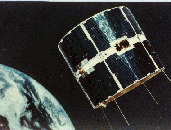
Artistic visualization of COS-B in orbit

The ESA mission COS-B, along with NASA’s SAS-2, provided the first detailed views of the Universe in gamma rays. COS-B carried a single large experiment, the Gamma Ray Telescope, which was responsibility of a group of European research laboratories know as the Caravane Collaboration. Launched on the 9 August 1975, COS-B was originally projected to last two years, but it operated successfully for 6 years and 8 months. It provided the first complete map of the Galaxy in gamma rays.

Mission Characteristics

Lifetime
9 Aug 1975–25 Apr 1982
Special Features
  • Observing time of 25 hours per 37 orbit, with pointing periods of four to five weeks in the early mission, extended to up to three months in later observations
  • Studied a broad portion of the galactic equator with deep observations
  • Mapping roughly 50% of the celestial sphere during the mission at gamma-ray wavelengths

Payload

Gamma Ray Telescope

Energy Range
∼ 30 MeV – 5 GeV
Effective Area
50 cm2 at 400 MeV
Energy Resolution
∼40% at 150 MeV (FWHM)
The Gamma-Ray Telescope consisted of a magnetic-core, wire-matrix, spark chamber, triggered by a three-element scintillation counter telescope. A plastic scintillator guard counter surrounding these two units served as an anti-coincidence detector to reject triggers due to incident charged particles and allow only gamma-rays to be detected. Beneath the telescope was an energy calorimeter, which absorbed the secondary particles produced by the incident photons.

Proportional Counter

Energy Range
2–12 keV
This detector was intended to provide synchronization of possible pulsed gamma-ray emission from pulsating X-ray sources.

Science Highlights

  • Observations of gamma-ray pulsars and binary systems
  • Gamma ray map of the Galaxy
  • Detailed observations of the Geminga gamma-ray pulsar

Archive

The HEASARC hosts raw data, images, and exposure maps from the gamma-ray telescope