
Come analyze HEASARC, IRSA, and MAST data in the cloud! The Fornax Initiative is now welcoming all interested beta users.


The Ginga Satellite


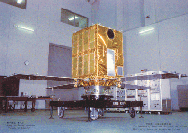
Photograph of Ginga in the clean room

Astro-C, renamed Ginga (Japanese for “galaxy”), was launched from the Kagoshima Space Center on 5 February 1987. The primary instrument for observations was the Large Area Counter (LAC). Ginga was the third Japanese X-ray astronomy mission, following Hakucho and Tenma. Ginga reentered the Earth’s atmosphere on 1 November 1991.

Mission Characteristics

Lifetime
5 Feb 1987–1 Nov 1992
Special Features
The Ginga observing program was open to scientists from Japan, the UK, the USA, and a number of European countries.

Payload

Large Area Proportional Counter (LAC)

Energy Range
1.5 – 30 keV
Effective Area
4000 cm2
Field of View
0.8° × 1.7° (FWHM)
Energy Resolution
<20% at 5.9 keV (FWHM)
The field of view was arranged with the longer side parallel to the spacecraft Z-axis, and was defined by honeycomb collimators made of thin stainless steel sheets. The counters were filled with a gas mixture of 70 percent argon, 25 percent xenon, and 5 percent carbon dioxide to a total pressure of 2 atmospheres at 20 degrees Celsius.

Accepted X-ray events were pulse-height analyzed into a maximum of 48 pulse height channels. The time resolution was mode-dependent. The highest time resolution available was 0.98 milliseconds, achieved at the expense of spectral information. The detection limit for the LAC was approximately 0.1 milliCrab, or 2.4 × 10⁻¹² ergs/cm2/s in the range 2–10 keV.

All-Sky Monitor (ASM)

Energy Range
1–20 keV
Field of View
1° × 45° (FWHM) each
The All-Sky Monitor (ASM) consisted of 2 identical gas proportional counter. Each counter was equipped with a collimator which had 3 different fields of view. The aim of the ASM was to create an all-sky survey every 1-2 days to look for transient events (to alert the LAC) and to collect a long-term record for X-ray sources.

Gamma Ray Burst Detector (GBD)

Energy Range
1.5–500 keV
Effective Area
60 cm (SC)
63 cm2 (PC)
Field of View
4π sr (all-sky)
Time Resolution
31.3 ms
The purpose of the Gamma-Ray Burst Detector (GBD) was to detect gamma-ray bursts with high-energy resolution. It was comprised of two sensors: a proportional counter (PC) and a scintillation spectrometer (SC). The GBD could also operate as a radiation belt monitor for high particle backgrounds which could harm the other 2 experiments.

Science Highlights

  • Discovery of transient black hole candidates and study of their spectral evolution
  • Discovery of weak transients in the galactic ridge
  • Detection of cyclotron features in 3 X-ray pulsars: 4U1538-522, V0332+53, and Cep X-4
  • Evidence for emission and absorption Fe feature in Seyfert probing reprocessing by cold matter
  • Discovery of intense 6–7 keV iron line emission from the galactic center region

Archive

The HEASARC hosts lightcurves, spectra, and raw data from the LAC experiments