
Come analyze HEASARC, IRSA, and MAST data in the cloud! The Fornax Initiative is now welcoming all interested beta users.


The Granat Satellite
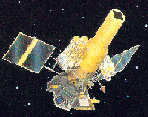

Artistic impression of Granat

Granat (“Garnet”) was a Russian dedicated X-ray/gamma ray astronomy mission operated in collaboration with other European countries. Launched on 1 December 1989, Granat operated for almost 9 years. After an initial period of pointed observations, Granat went into survey mode in September 1994

Mission Characteristics

Lifetime
1 Dec 1989–7 Nov 1998

Payload

Coded Mask X-ray Telescope (SIGMA)

Energy Range
0.03–1.3 MeV
Effective Area
800 cm2
Field of View
5′ × 5′
Angular Resolution
10′ maximum
The SIGMA telescope was a collaboration between CESR (Toulouse), CEA (Saclay), and IKI (Moscow). Its imaging capabilities were derived from the association of a coded mask and a position sensitive detector based on the Anger camera principle.

Astronomical Roentgen Telescope Imager (ART-P)

Energy Range
4–60 keV (imaging)
4–100 keV (spectra)
Effective Area
630 cm2 each
2520 cm 2 total
Field of View
1.8° × 1.8° (FWHM)
Angular Resolution
5′
Sensitivity
1 mCrab in an 8 hour exposure
Energy Resolution
25% at 5.9 keV
14% at 59.6 keV
Time Resolution
4 ms
The ART-P and ART-S instruments were both the responsibility of the IKI in Moscow. The ART-P telescope consisted of four modules. Each module a position sensitive Multi-Wire Proportional Counter (MWPC) together with a Uniformly Redundant Array (URA) coded mask.

Astronomical Roentgen Telescope Spectrometer (ART-S)

Energy Range
3–100 keV
Effective Area
625 cm2 each, 2400 cm 2 total at 10 keV
800 cm2 total at 100 keV
Field of View
2.1° × 2.1° (FWHM)
Energy Resolution
21% at 5.9 keV
11% at 59.5 keV
Time Resolution
200 µs
The ART-P and ART-S instruments were both the responsibility of the IKI in Moscow. Each consisted of a MWPC together with a URA coded mask. The ART-S collimator was mounted with a rocking mechanism to tilt off-source for background measurements.

Wide Angle Telescope for Cosmic Hard X-rays (WATCH)

Energy Range
6–180 keV
Effective Area
45 cm2
Field of View
All sky
Angular Resolution
0.5°
Energy Resolution
30% at 60 keV (FWHM)
There were four WATCH instruments, designed by the Danish Space Research Institute, on the Granat observatory starting in January 1990. The instruments could localize bright sources using a Rotation Modulation Collimator. During quiet periods, count rates in 2 energy bands (6–15 keV, 15–180 keV) were accumulated for 4, 8, or 16 s, depending on memory filling. During a burst or transient event, count rates were accumulated with a time resolution of 1 second into 36 energy channels. The WATCH system also flew on the EURECA mission.

Phénomènes Brefs de l’Univers (PHEBUS)

Energy Range
100 keV – 100 MeV
Effective Area
100 cm2 each
600 cm2 total
Field of View
All sky
Time Resolution
∼100 µs
The PHEBUS experiment was designed by CESR (Toulouse) to record high energy transient events. It consisted of 2 independent detectors with their associated electronics. Each detector consisted of a BGO crystal 78 mm in diameter by 120 mm thick, surrounded by a plastic anti-coincidence jacket. The 2 detectors were arranged on the spacecraft so as to observe ∼4π steradians. The burst mode was triggered when the count rate in the 0.1–1.5 MeV energy range exceeded the background level by 8 sigma in either 0.25 or 1.0 seconds. There were 116 energy channels.

Téléscope Optique à l'Université de Toulouse pour l'Étude des Sources Optiques Liées aux Sources Gamma (TOURNESOL)

Energy Range
2 keV – 8 MeV
Field of View
6° × 6° (high energy)
5° × 5° (visible)
The French TOURNESOL instrument consisted of 4 proportional counters and 2 optical detectors. The instrument was designed to look for optical counterparts of high-energy burst sources, as well as performing spectral analysis of the high-energy events.

Krypton Optical Nuclear Universal Spectrometer (KONUS-B)

Energy Range
10 keV – 8 MeV
The KONUS-B instrument, designed by the Ioffe Physical-Technical Institute in St. Petersburg, consisted of 7 detectors distributed around the spacecraft. They consisted of NaI(Tl) scintillator crystals 200 mm in diameter × 50 mm thick, with a Be entrance window. The side surfaces were protected by a 5 mm thick lead layer. The KONUS-B instrument operated from 11 December 1989 until 20 February 1990. Over that period, the “on” time for the experiment was 27 days. Some 60 solar flares and 19 cosmic gamma-ray bursts were detected.

Science Highlights

  • A very deep (more than 5 million sec.) imaging of the galactic center region
  • Discovery of electron-positron annihilation lines from the Galactic “micro-quasar” 1E1740-294 and the X-ray Nova Muscae
  • Study of spectra and time variability of black hole candidates

Archive

The HEASARC hosts the PHEBUS Gamma-Ray Burst Catalog