
Come analyze HEASARC, IRSA, and MAST data in the cloud! The Fornax Initiative is now welcoming all interested beta users.


The Hakucho [CORSA-B] Satellite
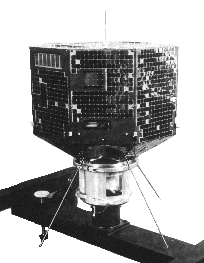

Image of Hakucho

Corsa-B was the first X-ray astronomy Japanese satellite. Launched on 21 February 1979, it was renamed Hakucho (Japanese for “swan”) symbolizing one of the most interesting X-ray objects, Cyg X-1. As many other X-ray satellite launched in that period, Hakucho was designed to study and monitor transient phenomena with particular emphasis on X-ray bursts. It was still operating when the second X-ray Japanese satellite Tenma launched in 1983.

Mission Characteristics

Lifetime
21 Feb 1979–16 Apr 1985

Payload

Very Soft X-ray experiment (VSX)

Energy Range
0.1–0.2 keV
Effective Area
∼78 cm2 each
Field of View
6.3° × 2.9° (P; parallel)
24.9° × 2.9° (V; offset)
Four identical proportional counters with a thin polypropylene window. Two of counters (P) were located in a direction almost parallel to the spin axis at 2.7° offset. The other two (V) where located offset to the spin axis tilted 45°.

Soft X-ray experiment (SFX)

Energy Range
1.5–30 keV
Effective Area
69 cm2 (CMC)
40 and 83 cm2 (FMC)
32 cm2 (V)
Field of View
17.6° (CMC)
5.8° (FMC)
50.3° × 1.7° (V)
SFX consisted in 6 proportional counters with a Be window. Four of the counters (P divided in two CMC and two FMC) have a viewing direction parallel to the spin axis and the other two (V) were 45° tilted.

Hard X-ray experiment (HDX)

Energy Range
10–100 keV
Effective Area
45 cm2
Field of View
4.4° × 10.0° (FWHM)
HDX was a single NaI(Tl) scintillation counter located parallel to the spin axis with a small offset of 3°.

The instrument could be operated with different modes providing different energy and time resolution (with 5.86 ms minimum).

Science Highlights

  • Discovery of soft X-ray transient Cen X-4 and Aql X-1
  • Discovery of many burst sources
  • Long-term monitoring of X-ray pulsar (e.g. Vela X-1)
  • Discovery of 2 Hz variability in the Rapid Burster later named Quasi Period Oscillation

Archive

No data is available at the HEASARC