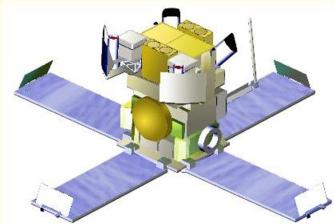
HETE-2, also known as the High Energy Transient Explorer was an international collaboration between USA, Japan, France, and Italy, headed by the Center for Space Research at MIT. It was successfully launched with a Pegasus launcher, on October 9 2000 from the Kwajalein missile range facility, an atoll in the Pacific ocean.
HETE-2 was designed to detect and localize gamma-ray bursts (GRBs). The suite of instruments onboard allowed simultaneous observations of GRBs to be made in soft and medium X-ray and gamma-ray energies. HETE-2 computed the location of the GRB and transmitted the coordinates as soon as they were calculated. These coordinates were quickly distributed to ground-based observers to allow detailed studies of the initial phases of GRBs. HETE-2 also performed a survey of the X-ray sky.
Mission Characteristics
Lifetime
9 Oct 2000–Mar 2008
Special Features
All instruments pointed in the anti-solar direction and shared a common field of view of ∼1.5 steradians
Lifetime
9 Oct 2000–Mar 2008
Special Features
All instruments pointed in the anti-solar direction and shared a common field of view of ∼1.5 steradians
Payload
Instrument
Characteristic
Details
Soft X-ray Camera (SXC)
Energy Range
0.5–14 keV
Effective Area
7.4 cm2 each
Field of View
∼0.9 sr
Angular Resolution
<30″
Energy Resolution
46 eV at 525 eV 129 eV at 5.9 keV
Two CCD-based one-dimensional coded-aperture X-ray imagers, one along spacecraft X-direction, the other parallel to Y-direction.
Wide Field X-ray Monitor (WXM)
Energy Range
2–25 keV
Effective Area
175 cm2
Angular Resolution
<10′
Energy Resolution
∼22% at 8 keV
Two coded-mask one-dimensional position sensitive X-ray detectors oriented orthogonally to each other to measure X and Y positions independently.
French Gamma Ray Telescope (FREGATE)
Energy Range
6–400 keV
Effective Area
120 cm2
Field of View
∼3 sr
Energy Resolution
∼25% at 20 keV ∼9% at 662 keV
4 NaI(Tl) gamma-ray detectors
Soft X-ray Camera (SXC)
Energy Range
0.5–14 keV
Effective Area
7.4 cm2 each
Field of View
∼0.9 sr
Angular Resolution
<30″
Energy Resolution
46 eV at 525 eV 129 eV at 5.9 keV
Two CCD-based one-dimensional coded-aperture X-ray imagers, one along spacecraft X-direction, the other parallel to Y-direction.
Wide Field X-ray Monitor (WXM)
Energy Range
2–25 keV
Effective Area
175 cm2
Angular Resolution
<10′
Energy Resolution
∼22% at 8 keV
Two coded-mask one-dimensional position sensitive X-ray detectors oriented orthogonally to each other to measure X and Y positions independently.
French Gamma Ray Telescope (FREGATE)
Energy Range
6–400 keV
Effective Area
120 cm2
Field of View
∼3 sr
Energy Resolution
∼25% at 20 keV ∼9% at 662 keV
4 NaI(Tl) gamma-ray detectors
Science Highlights
Real-time localizations of >80 GRBs with arcminute accuracy, enabling ground-based follow-up in optical, IR, and radio wavelengths. Prior to HETE-2, very few GRBs had identified optical counterparts
Confirmed that long GRBs are associated with the collapse of massive stars (“collapsars”)
Provided an observational bridge between BATSE on CGRO and later missions such as Swift
Archive
The HEASARC hosts the FREGATE GRB lightcurves and raw telemetry data