
Come analyze HEASARC, IRSA, and MAST data in the cloud! The Fornax Initiative is now welcoming all interested beta users.


The OSO-7 Satellite


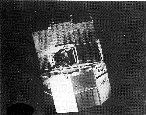
Visualization of the OSO 7 satellite

The Seventh Orbiting Solar Observatory (OSO 7) like the other Orbiting Solar Observatory missions, was primarily a solar observatory designed to point a battery of UV and X-ray telescopes at the Sun from a platform mounted on a cylindrical wheel. The detectors for observing cosmic X-ray sources were the X-ray proportional counters, built by MIT, the hard X-ray telescope by UC San Diego and the Gamma Ray Monitor by the University of New Hampshire.

Mission Characteristics

Lifetime
29 Sep 1971–9 Jul 1975
Special Features
The proportional counters and hard X-ray telescope on board OSO-7 scanned the entire sky and obtained good exposure of point sources through repeated scans

Payload

MIT instrument

Energy Range
1–60 keV
Field of View
1° and 3° tubular collimators (FWHM)
Time Resolution
3.2 min
Just under three years of data on celestial X-ray sources were obtained using the MIT instrument. The detection system consisted of two banks of proportional counters which viewed the sky through tubular collimators in five broad energy intervals (1–1.5 keV; 1–6 keV; 3–10 keV; 15–40 keV; 30–60 keV). The data were recorded in 256 azimuthal bins as the detector scanned across a small circle on the sky with each spin.

USCD X-ray telescope

Energy Range
7–550 keV
Effective Area
∼64 cm2
Field of View
6.5° (FWHM)
Energy Resolution
128 energy loss channels
Time Resolution
0.625 ms
The UCSD OSO-7 X-ray telescope consisted of a 1 cm thick NaI(Tl) crystal inside a massive CsI(Na) anti-coincidence shield. The total detector weight was 85 lbs.

UNH gamma-ray monitor

Energy Range
300 keV – 10 MeV
Energy Resolution
7.8% at 662 keV
Time Resolution
0.5 s bins in sunward/anti-sunward direction each 2 s spin
The UNH gamma-ray monitor consisted of a 7.6×7.6 cm NaI(Tl) scintillator. The detector was surrounded on all sides by a ∼4 cm thick CsI(Na) scintillator cup. The exception was a forward aperture which was covered by a 0.5 cm thick CsI(Na) slab. The instrument was calibrated regularly each orbit with a 60Co source. The instrument was in the wheel section of OSO-7. The monitor operated until 25 December 1972, but was usually turned off during the periodic penetration of the satellite into the radiation belts.

Science Highlights

  • X-ray All-sky survey
  • Results for compact galactic sources: Sco X-1, Her X-1 and Cyg X-1, as well as results of observations of the supernova remnant IC 443, supernova 1972e, and a unique flare source, GX 354+3.
  • Discovery of the 9-day periodicity in Vela X-1 which led to its optical identification as a high mass X-ray binary star system
  • 4.8 hr period present in Cyg X-3 in 6–21 keV range, but absent in 21–98 keV range
  • A “multi-color” catalog of 184 sources (Markert et al., 1979)
  • Detection of rapid intensity variability from Centaurus A (Winkler & White, 1975)
  • Studied the high energy temporal and spectral behavior of a number of sources including Her X-1 (Ulmer et al., 1973) and Vela X-1 (Ulmer et al., 1972)
  • Gamma-ray observations of solar flares

Archive

No data available at the HEASARC. The NSSDC holds the OSO 7 data in native raw format.