
Come analyze HEASARC, IRSA, and MAST data in the cloud! The Fornax Initiative is now welcoming all interested beta users.


The Small Astronomy Satellite 2 (SAS-2)
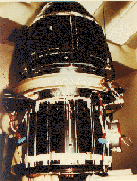

Photograph of SAS-2

The second NASA Small Astronomy Satellite (SAS-2) was dedicated to gamma-ray astronomy in the energy range above 35 MeV. SAS-2 was launched on 1972 November 15 and began operations on 1972 November 19.

To minimize the background flux from cosmic-rays, SAS-2 was placed in a low Earth equatorial orbit having a 2 degree orbital inclination. Its apogee and perigee were 610 km and 440 km respectively, with an orbital period of about 95 minutes.

During the ∼6 months of the mission, 27 pointed observations (typically a week in duration) were made, resulting in about 55 percent of the sky being observed, including most of the galactic plane. On 8 June 1973, a failure of the low-voltage power supply ended the collection of data.

Mission Characteristics

Lifetime
19 Nov 1972–8 Jun 1973

Payload

spark chamber

Energy Range
20 MeV – 1 GeV
Effective Area
540 cm2
The SAS-2 satellite carried a single instrument: a gamma-ray telescope that used a 32-level wire spark-chamber. The telescope covered the energy range 20 MeV – 1 GeV. The instrument was the work of Fichtel et. al. at NASA-GSFC. During the short lifetime of the mission, there was some noticeable decrease in sensitivity due to deterioration of the spark-chamber gas.

Science Highlights

  • The first detailed look at the gamma-ray sky
  • Established the high energy component of diffuse celestial radiation
  • Correlated the gamma-ray background with galactic structural features

Archive

The HEASARC hosts raw data, images, and exposure maps