Effective Area
75 cm2 each
Field of View
1° × 32° (center)
0.5° × 32° (left and right) (FWHM)
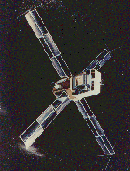
3 crossed slat collimators each with proportional counter. They were designed to monitor a large portion of the sky in a wide band of directions centered on the plane perpendicular to the rotation axis of the satellite (+Z). Each detector consisted of a proportional counter and collimator with an on-axis effective area of 75 cm2. The collimators define 3 long, narrow fields of view which intersect on the +Y axis and are inclined with respect to the YZ plane of the satellite at angles of -30°, 0°, and +30°, respectively. During scanning mode, an X-ray source would appear successively in the 3 detectors. Three lines of position could then be obtained, and their intersection determined the true source position. The center collimator had a field of view with FWHM 1° by 32° and a FW of 2° by 120°. The left and right collimators had narrower, but similar responses, i.e., 0.5° × 32° (FWHM) and 1.0° × 100° (FW). The proportional counters were filled with argon and were sensitive in the range 5–15 keV. In addition the center detector had also a xenon counter, located behind the argon detector, that extend the response to 60 keV. Over the energy range 1.5–6 keV, 1 count/s = 1.5 × 10⁻¹⁰ ergs/cm2/s for a Crab-like spectrum. In any given orbit, ∼60% of the sky was scanned by the center slat detector with an exposure ranging from 300–1125 cm2 sec.