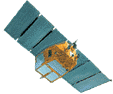
BeppoSAX was a major program of the Italian Space Agency with participation of the Netherlands Agency for Aereospace Programs (NIVR) and the Space Science Department of ESA. It was launched on April 30 1996 from Cape Canaveral and operated for 6 years. It was the first X-ray mission with a scientific payload covering more than three decades of energy — from 0.1 to 300 keV — with a relatively large effective area, medium energy resolution and imaging capabilities in the range of 0.1-10 keV.
The ancronym SAX stands for Satellite per Astronomia X (X-ray Astronomy Satellite in Italian), and was renamed BeppoSAX to honor Giueppe (“Beppo”) Occhialini. Due to degrading spacecraft conditions and rapid orbital decay, science operations ceased on April 30, 2002. BeppoSAX re-entered the Earth’s atmosphere on April 29, 2003.
Mission Characteristics
Lifetime
30 Apr 1996 – 30 Apr 2002
Special Features
Rapid X-ray follow up to GRB detection onboard
Broad band energy coverage
Lifetime
30 Apr 1996 – 30 Apr 2002
Special Features
Rapid X-ray follow up to GRB detection onboard
Broad band energy coverage
Payload
The BeppoSAX detectors were divided into the Narrow Field Instruments (NFI) and Wide Field Cameras (WFCs). The NFI suite (LECS, MECS, HPGSPC, and PDS) were all co-aligned along the Z axis of the satellite, allowing broad-band spectroscopy on the target source. WFCs were mounted orthogonally to NFI and opposite to each other.
Instrument
Characteristic
Details
Low Energy Concentrator Spectrometer (LECS)
Energy Range
0.1–10 keV
Effective Area
22 cm2 at 6 keV
Field of View
37′ diameter
Angular Resolution
9.7′ FWHM at 0.28 keV
The single LECS unit used a Wolter Type 1 X-ray grazing incidence mirror telescope to focus soft X-ray onto the gas scintillation proportional counter with xenon gas for X-ray detection, with a few percent methane gas for quenching, to improve proportionality of the response, and reduce spurious events
Medium Energy Concentrator Spectrometer (MECS)
Energy Range
1.3–10 keV
Effective Area
50 cm2 each; 150 cm2 total
Field of View
37′ diameter
Angular Resolution
75″ at 6 keV (FWHM)
There were three MECS units each with a Wolter Type 1 X-ray grazing incidence mirror telescope. Each MECS was similar to the LECS unit, but with thicker entrance windows and operating at a higher gas pression to improve efficiency at higher energies.
High Pressure Gas Scintillation Proportion Counter (HPGSPC)
Energy Range
4–120 keV
Effective Area
240 cm2 at 30 keV
Field of View
≈1° (FWHM)
Energy Resolution
4–5% at 60 keV
The HPGSPC instrument (often shortened to just GSPC) used hexagonal-cell collimators rather than X-ray optics to define its field of view. The collimators used a rocking design to switch on and off sources for observations of source and background, with a typical tilt angle of ±3° allowing near-simultaneous background measurements, with alternating on- and off-source dwell times of roughly 96 seconds. The instrument was surrounded by lead and tungsten passive shielding to reduce off-axis signals, plus an active anti-coincidence shielding on the lateral and rear sides made from plastic scintillator. The gas mixture was maintained at 5 bar (roughly 5 times atmospheric pressure) to improve high energy sensitivity.
Phoswich Detection System (PDS)
Energy Range
15–300 keV
Effective Area
600 cm2 at 80 keV
Field of View
≈1.3° (FWHM)
Energy Resolution
15–20% at 60 keV
The PDS used a hexagonal collimator with a rocking design similar to the GSPC. The phoswich (phosphor sandwich) detector used optically coupled NaI(Tl) and CsI(Na) crystals imaged by a photomultiplier tube. The crystals had differing decay times allowing pulse discrimination for veto selection. The lateral CsI shields of the PDS were also used as gamma-ray burst monitors in the energy range 60–600 keV.
Wide Field Camera
Energy Range
2–30 keV
Effective Area
≈140 cm2 at 6 keV
Field of View
40° × 40° (full width at zero response)
Angular Resolution
≈5′
There were two WFC units, each pointed orthogonally to the NFI and opposite to each other for the widest possible sky coverage. Each camera consisted of a coded mask aperature with an open element fraction of roughly 27% mounted in front of a multi-wire position sensitive proportial counter.
Low Energy Concentrator Spectrometer (LECS)
Energy Range
0.1–10 keV
Effective Area
22 cm2 at 6 keV
Field of View
37′ diameter
Angular Resolution
9.7′ FWHM at 0.28 keV
The single LECS unit used a Wolter Type 1 X-ray grazing incidence mirror telescope to focus soft X-ray onto the gas scintillation proportional counter with xenon gas for X-ray detection, with a few percent methane gas for quenching, to improve proportionality of the response, and reduce spurious events
Medium Energy Concentrator Spectrometer (MECS)
Energy Range
1.3–10 keV
Effective Area
50 cm2 each; 150 cm2 total
Field of View
37′ diameter
Angular Resolution
75″ at 6 keV (FWHM)
There were three MECS units each with a Wolter Type 1 X-ray grazing incidence mirror telescope. Each MECS was similar to the LECS unit, but with thicker entrance windows and operating at a higher gas pression to improve efficiency at higher energies.
High Pressure Gas Scintillation Proportion Counter (HPGSPC)
Energy Range
4–120 keV
Effective Area
240 cm2 at 30 keV
Field of View
≈1° (FWHM)
Energy Resolution
4–5% at 60 keV
The HPGSPC instrument (often shortened to just GSPC) used hexagonal-cell collimators rather than X-ray optics to define its field of view. The collimators used a rocking design to switch on and off sources for observations of source and background, with a typical tilt angle of ±3° allowing near-simultaneous background measurements, with alternating on- and off-source dwell times of roughly 96 seconds. The instrument was surrounded by lead and tungsten passive shielding to reduce off-axis signals, plus an active anti-coincidence shielding on the lateral and rear sides made from plastic scintillator. The gas mixture was maintained at 5 bar (roughly 5 times atmospheric pressure) to improve high energy sensitivity.
Phoswich Detection System (PDS)
Energy Range
15–300 keV
Effective Area
600 cm2 at 80 keV
Field of View
≈1.3° (FWHM)
Energy Resolution
15–20% at 60 keV
The PDS used a hexagonal collimator with a rocking design similar to the GSPC. The phoswich (phosphor sandwich) detector used optically coupled NaI(Tl) and CsI(Na) crystals imaged by a photomultiplier tube. The crystals had differing decay times allowing pulse discrimination for veto selection. The lateral CsI shields of the PDS were also used as gamma-ray burst monitors in the energy range 60–600 keV.
Wide Field Camera
Energy Range
2–30 keV
Effective Area
≈140 cm2 at 6 keV
Field of View
40° × 40° (full width at zero response)
Angular Resolution
≈5′
There were two WFC units, each pointed orthogonally to the NFI and opposite to each other for the widest possible sky coverage. Each camera consisted of a coded mask aperature with an open element fraction of roughly 27% mounted in front of a multi-wire position sensitive proportial counter.
Science Highlights
First arc-minute accuracy positions of GRBs with position determine on a rapid time scale
First X-ray follow-up observations and monitoring of GRBs
Determination that GRBs are at cosmological distances
Broad band spectroscopy of different classes of X-ray sources
Archive
The HEASARC host spectra, light curves, images, and raw data from MECS, LECS, and PDS.