
Come analyze HEASARC, IRSA, and MAST data in the cloud! The Fornax Initiative is now welcoming all interested beta users.


The Tenma [Astro B] Satellite
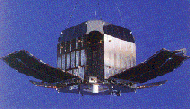

Photograph of Tenma

Astro B was the second Japanese X-ray astronomy satellite. After launch on February 20, 1983, it was renamed Tenma (Japanese for “Heavenly Horse” or “Pegasus”). Tenma carried GSFC detectors which had an improved energy resolution (by a factor of 2) compared to proportional counters and performed the first sensitive measurements of the iron spectral region for many astronomical objects.

Mission Characteristics

Lifetime
20 Feb 1983–22 Nov 1985
Special Features
  • Suite of instruments covering a wide energy range for simultaneous observations at soft and hard X-ray wavelengths
  • while primarily a Japanese mission, it included contributions from U.S. and European researchers. It established Japan as a major contributor to X-ray astronomy.

Payload

Gas Scintllator Proportional Counter

Energy Range
2–60 keV
Effective Area
80 cm2 each
Field of View
3.1° FWHM (SPC-A)
2.5° FWHM (SPC-B)
3.8° FWHM (SPC-C)
Energy Resolution
9.5% at 6 keV
This was the primary instrument on the satellite. Its main objective was the spectral and temporal study of cosmic X-ray sources. It consisted of 10 gas scintillation proportional counters (GSPC). The ten counters were divided into three groups SPC-A, B and C, with slightly different fields of view through honeycomb collimators. The A and B consisted of 4 counters each, the C instead consisted of 2 counters.

X-ray Focusing Collimator

Energy Range
0.1–2 keV
Effective Area
7 cm2 each at 0.7 keV
Field of View
5° × 0.2° (FWHM), divided into 7 resolution elements
The system consisted of 2 identical co-aligned subsystems, each with a position sensitive proportional counter.

Transient Source Monitor

Energy Range
2–10 keV
Field of View
45° radius
This instrument carried out continuous monitoring of a wide field of the sky. It consisted of 2 detector groups: (1) a Hadamard X-ray telescope and (2) a scanning counter.

Radiation Belt Monitor/Gamma Ray Burst Detector

Energy Range
10–100 keV
Effective Area
7 cm2 each
Sensitivity
∼10-5 erg/cm2 detection limit at 1/8 s time resolution
Time Resolution
1/8 s
2 sets of scintillation counters. Their primary purpose was to monitor the background variations. They were also used as alarms for satellite entry into the radiation belts, and detect gamma-ray bursts.

Science Highlights

  • Discovery of the Iron helium-like emission from the galactic ridge
  • Iron line discovery and/or study in many low- and high-mass x-ray binaries and active galactic nuclei
  • Discovery of an absorption line at 4 keV in the X1636-536 burst spectra

Archive

No data available at the HEASARC