
Come analyze HEASARC, IRSA, and MAST data in the cloud! The Fornax Initiative is now welcoming all interested beta users.


The HEAO-1 Satellite


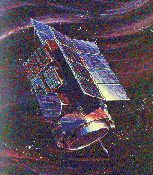
Visualization of HEAO-1 in orbit

Beginning in 1977, NASA launched a series of very large scientific payloads called High Energy Astronomy Observatories (HEAO). The first of these missions, HEAO-1 surveyed the X-ray sky almost three times over the 0.2 keV – 10 MeV energy band, provided nearly constant monitoring of X-ray sources near the ecliptic poles. More detailed studies of a number of objects were made through pointed observations lasting typically 3-6 hours.

Mission Characteristics

Lifetime
12 Aug 1977–9 Jan 1979
Special Features
  • First of NASA’s large dedicated high energy astronomy missions
  • Combined program of all-sky scans and pointed observations

Payload

A1 – NRL Large Area Sky Survey (LASS)

Energy Range
0.25–25 keV
Effective Area
1350–1900 cm2 each
Field of View
1° × 0.5° (fine)
1° × 4° (coarse)
Time Resolution
5 or 320 ms modes
The A1 experiment consisted of seven thin-window large aperture proportional counter modules with collimators of varying fields of view. Six of these modules were mounted on the -Y side of the spacecraft, the seventh on the +Y side. The Z-axis of the spacecraft pointed toward the Sun so the viewing directions of the seven A-1 detectors were roughly perpendicular to the solar direction. The experiment had sufficient sensitivity to detect sources as faint as 0.25 µJy at 5 keV for sources with a Crab-like spectrum. Data was collected in either a 5 or a 320 millisecond timing resolution mode: Full sky coverage for both time resolutions was achieved before the mission’s end.

A2 – Cosmic X-ray Experiment (CXE)

Energy Range
0.15–3.0 keV (LED)
1.5–20 keV (MED)
2.5–60 keV (HED)
Effective Area
400 cm2 each (LED)
800 cm2 (MED)
800 cm2 each (HED)
Field of View
1.5° × 3°, 3° × 3° and 3° × 6° (FWHM) collimators on MED and HED
The experiment consisted of 6 separate multi-anode, multi-layer, collimated gas proportional counters covering three energy ranges. Two of the detectors, designated LEDs (Low Energy Detectors), were thin-window propane filled proportional counters. There was one MED (Medium Energy Detector) which consisted of an argon filled counter. Finally, there were 3 HEDs (High Energy Detectors), which were xenon filled counters. The HEDs and the MED had various collimators which were oriented so that the 3° angular response was always perpendicular to the scan plane. Thus, each rotation of the satellite scanned a great circle 3 degrees wide on the sky passing through the ecliptic poles

A3 – MIT/SAO Modulation Collimator (MC)

Energy Range
0.9–13.3 keV
Effective Area
400 cm2 (MC1)
300 cm (MC2)
Field of View
4° × 4° collimator
Angular Resolution
∼2′
The A3 instrument consisted of two four-grid modulation collimators. The angular response of the collimators is a series of transmission bands separated by 8 times the FWHM of each band. In this case the bands are 30″ and 2′ FWHM, separated by 4′ and 16′, respectively for the individual collimators. Each collimator measures position in one dimension, perpendicular to its transmission bands. The X-rays were detected by four sealed proportional counters placed behind each collimator. The 30′ collimator (MC1) had a net effective area of 400 cm2 maximum. One of the MC2 counters failed 2 weeks after launch giving it a net area of 300 cm2. The expected sensitivity of ∼1 Uhuru count/s after two all-sky scans was sufficient to detect any of the then-known 1–10 keV sources.

A4 – UCSD/MIT Hard X-ray / Low Energy Gamma Ray Experiment

Energy Range
12–200 keV (low)
80 keV – 2 MeV (medium)
120 keV – 10 MeV (high)
Effective Area
100 cm2 each (low)
45 cm2 each (medium)
100 cm2 (high)
Field of View
1.7° × 20° (low)
17° circular (medium)
37° circular (high)
The A4 experiment consisted of seven inorganic phoswich scintillator detectors surrounded by massive scintillators which served as active anti-coincidence against ambient radiations. The two Low Energy Detectors were collimated with slats to a fan beam. The slats were inclined at ±30° to the satellite scan direction.

Science Highlights

  • Complete flux-limited High Galactic Latitude Survey (Piccinotti et al. 1982)
  • Measurement of X-ray background from 3–50 keV (Marshall et al. 1980, ApJ, 235, 4)
  • Comprehensive catalog of X-ray sources (one for each experiment)
  • Several hundred optical companions and source classifications based on X-ray source positions
  • Monitored variability of a variety of objects from AGNs to X-ray binaries
  • Studied aperiodic variability in Cyg X-1 on timescales on a few milliseconds
  • Discovered the first eclipse seen in a low-mass X-ray binary

Archive

The HEASARC hosts catalogs, spectra, lightcurves, maps, and raw data